(Correspondent: Hu Qian)
To implement China’s strategic initiative for the digitalization of education, accelerate the integration of artificial intelligence with teaching and learning, and comprehensively enhance faculty members’ digital literacy and intelligent teaching capabilities, the School of Management and Chaoxing jointly held a workshop entitled “AI Empowerment: Enhancing Faculty Digital Literacy” on the morning of June 18, 2026, in Conference Room 425 of the Liberal Arts Building.
Program and course leaders and representatives of young faculty members attended the workshop, which was conducted in a combined online and in-person format. The event was chaired by Zhang Zongxiang, Vice Dean of the School.
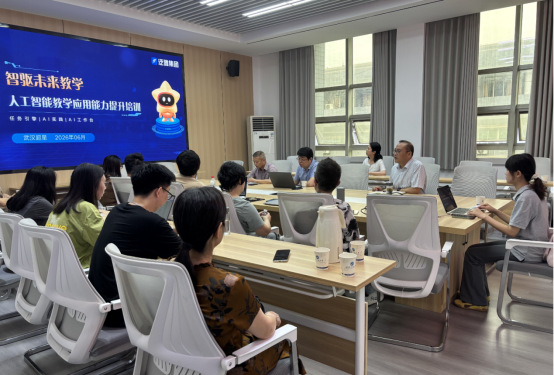
Focusing on the theme of “AI-Empowered Smart Classroom Teaching,” the training addressed the application of an integrated “Five Techniques in One” approach to smart courses and academic program development. It explored the use of intelligent technologies, including AI agents and knowledge graphs, as well as the integration of big data, artificial intelligence, and educational resources.
These applications can help faculty members provide instruction tailored to students’ individual needs, establish an environment conducive to personalized learning, strengthen students’ digital literacy, and promote the mutual advancement of teaching and learning.
The training advocated the development of a smart education ecosystem that is people-centered and guided by the principle of using technology for the common good. Drawing on two representative teaching cases, Ma Jinhua, an instructor from the Chaoxing platform, demonstrated the complete process of developing and improving courses on the platform.
Through hands-on exercises, participants gained an understanding of the diverse and innovative approaches available for constructing smart courses on Chaoxing, as well as pathways through which successful practices may be replicated and promoted more widely.
Participants stated that the workshop combined theoretical depth, practical applicability, and a forward-looking, innovative perspective. It not only provided effective solutions to practical challenges in smart teaching but also gave faculty members a new and more comprehensive understanding of AI-empowered education.
Going forward, the School will continue to advance the development of smart education and conduct digital teaching and professional development activities on a regular basis. It will encourage program and course leaders and young faculty members to play a leading and exemplary role by sharing what they have learned and promoting the application of successful outcomes.
The School will also guide all faculty members in continuously deepening the innovative integration of artificial intelligence with education and teaching, improving their digital literacy and classroom teaching quality, and contributing more effectively to the School’s talent cultivation.
(Reviewed by Zuo Hui)